Let’s talk

Curriculum Blog Posts

History that sticks: helping pupils think like historians
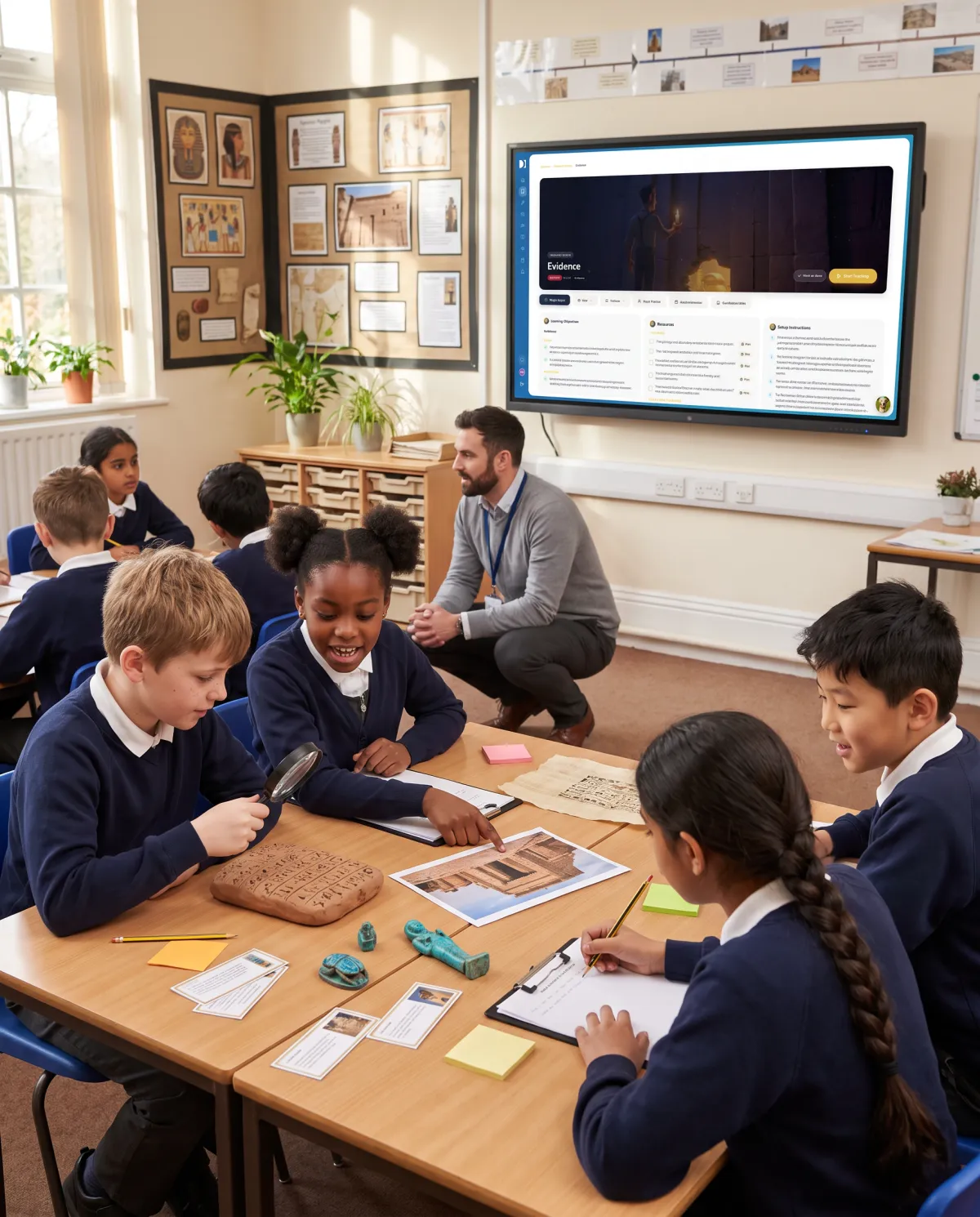
Pupils working with historical sources at their tables during a history lesson

There is a particular kind of silence you get in a history lesson when pupils are genuinely hooked. Not the “heads down, worksheet out” silence. The kind where they are deep in learning, trying to work something out and asking those questions.

“Why did people do that? How do we know? Who is telling the story? What might be missing?”

That is the heart of primary history. Yes, the National Curriculum is clear about the content pupils should encounter. But the real promise of history is bigger than a list of topics. It is about helping children build a coherent sense of time, develop a curiosity about people and places, and learn to handle evidence with care.

This first blog in our series looks at what it means to help pupils think like historians in primary, and how to make that learning stick.

What primary history is really for

The History Programmes of Study set out a clear purpose for primary history: pupils should develop a coherent knowledge and understanding of Britain’s past and that of the wider world. Alongside this, they should learn to ask questions, weigh evidence, and use historical concepts and vocabulary.

In other words, primary history is both:

  • Substantive knowledge: the people, events, places and periods pupils learn about
  • Disciplinary knowledge: the ways pupils learn to work with the past, including enquiry, evidence, interpretation and explanation

When pupils get both, history becomes more than “learning about the Romans” or “doing the Egyptians”. It becomes a growing toolkit for making sense of the world.

The habits of thinking that make history memorable

Here are five classroom habits that help pupils build strong historical thinking, whatever topic you are teaching.

1. Start with an enquiry that creates genuine curiosity

An enquiry question gives pupils a reason to learn. It turns content into a puzzle to solve.

Instead of leading with a topic title, try leading with a question that invites thought and debate:

  • “Was the Great Fire of London a disaster or an opportunity?”
  • “Did the Romans change Britain for the better?”
  • “What makes a civilisation ‘advanced’?”
  • “Why do historians disagree about this person?”

A good enquiry question is not a trick question. It is a question that can be answered in more than one way, as long as pupils can justify their thinking.

2. Teach chronology as a story of change over time

Chronology is not just a timeline on a wall. It is the thread that helps pupils connect what they learn into a coherent narrative.

In Key Stage 1, pupils are building the concept of “the past”. That often starts with what is closest and most meaningful: their own lives, their families, and familiar local contexts. From there, pupils can begin to explore “beyond living memory” and start to place events in a simple sequence.

In Key Stage 2, chronology becomes more ambitious. Pupils need help to locate periods, compare them, and understand overlap. A simple routine can make a big difference:

  • Place the new unit on a class timeline
  • Revisit what came before and what came after
  • Name what is changing and what is staying the same

Over time, pupils stop seeing history as disconnected topics and start seeing it as a developing picture.

3. Make evidence visible, tangible and discussable

Primary pupils can handle sources brilliantly when we teach them how.

Evidence does not have to mean dense text. It can include:

  • Artefacts and photographs
  • Paintings and maps
  • Short written accounts
  • Objects, replicas and museum images
  • Buildings, memorials and local landmarks

The key is to teach pupils to ask useful questions of sources. A simple three-part routine works well:

  • What can we see? (observations)
  • What might it tell us? (inferences)
  • What can it not tell us? (limits and gaps)

This is where pupils begin to understand that history is constructed from evidence, and that evidence always has boundaries.

4. Return to the big concepts again and again

The National Curriculum highlights concepts such as:

  • Continuity and change
  • Cause and consequence
  • Similarity and difference
  • Significance

These concepts are not “one lesson” ideas. They are lenses pupils need to practise using across many units.

A practical way to build this is to choose a small set of concept prompts that you use repeatedly:

  • “What changed? What stayed the same?”
  • “What caused this? Were there multiple causes?”
  • “Who benefited? Who was disadvantaged?”
  • “Why does this matter? To whom does it matter?”

When pupils meet the same concepts in different contexts, they build depth. They also gain language for explaining their thinking, not just recalling facts.

5. Teach interpretation carefully and confidently

Primary pupils are ready to understand that historians do not always agree.

Interpretation does not need to be complex. It can begin with simple, age-appropriate experiences:

  • Two accounts of the same event that emphasise different details
  • A portrait that presents someone in a particular way
  • A commemorative statue and a critical article about it

The goal is not to create cynicism. The goal is to help pupils understand that stories about the past are shaped by viewpoint, purpose and evidence.

A helpful phrase for the classroom is:

“This source is useful because… and limited because…”

That single sentence stem supports balanced thinking.

What this looks like in a lesson (a quick example)

Imagine you are teaching a unit on a local history study. You might begin with an enquiry question such as: “How has our local area changed, and why?” Pupils could examine a small set of sources: an old photograph, a modern photograph, a map extract, and a short written account. They discuss what they notice, what they can infer, and what they still need to find out.

As the unit progresses, pupils build a simple timeline of key changes, return to the concepts of continuity and change, and finish by answering the enquiry question with evidence. The content is important, but the thinking routines are what pupils carry forward into the next unit.

Supporting teachers and subject leaders

For teachers, the challenge is rarely enthusiasm. It is time, confidence and clarity. A well-designed history curriculum makes it easier to:

  • See how knowledge and concepts build across a key stage
  • Plan lessons that balance story, evidence and thinking
  • Ensure coverage without teaching history as a checklist
  • Support all pupils to participate and succeed

For subject leaders, it should also make it easier to articulate intent, implementation and impact. Not by producing more paperwork, but by making progression visible and coherent.

Bringing it all together

When pupils learn history well, they gain more than information about the past. They gain a growing sense of time, a richer understanding of people and societies, and the confidence to ask thoughtful questions.

If you would like to see how Dimensions Primary History scheme can support enquiry, chronology, evidence and progression across the primary years, you can access a free trial, or talk to one of our team to find out more.

What schools say about Dimensions.

“As a primary pupil referral unit, creating genuine engagement is essential for our learners. We were looking for a curriculum that places children at the heart of everything and encourages them to immerse themselves in purposeful, meaningful activities. Dimensions has proved to be a strong fit because it enables our pupils to be active, curious learners rather than passive recipients of information. It brings learning to life in a way that motivates them and supports high-quality learning throughout. Plus, the children just love the curriculum!”
BThe Beacon Referral Unit
“Our school fully embraced the Dimensions curriculum and it has brought the world to our classrooms!”
AAlison Steen
“As a school we are really pleased with our decision to go with Dimensions. It has changed the way we teach our topic lessons as a school and has elevated the quality and diversity of the topics taught throughout KS1 and KS2. It is wonderful how the same theme can be so diverse across all age ranges and it has given teachers the confidence to explore themes they may not have taught previously.”
Scoill Phurt Le Moirrey
“Dimensions Curriculum is amazing! We’ve used it for a few years now and the children absolutely love the different topics and are really engaged by the modern and relevant aspect of these. … Added to this is the amazing support that you get from the Dimensions team and nothing is ever too much trouble.”
SSophie Orton
“Introducing the curriculum has been a real game-changer for our team. It’s clear, well-structured, and genuinely supportive of high-quality teaching. Planning is now more streamlined and consistent, while still allowing flexibility for individual classes and teaching styles. The progression is easy to follow, expectations are clear, and it’s saved us valuable time without compromising creativity or impact. A thoughtfully designed resource that’s already making a positive difference in our classrooms.”
Woodford Halse School
“As a class teacher I have really enjoyed using both the Dimensions Curriculum and 3D PSHE. Both products have been very well designed with clear, progressive and sequential plans, incorporating creative, engaging ideas and have given me the peace of mind to know I am teaching the children a quality curriculum. Wouldn’t expect anything less from a product designed by teachers, for teachers. Thank you Dimensions team!”
AAnn Webster
“The Dimensions 3D PSHE curriculum map, programs of study and enrichment unit are so well organised! I am very excited to use it all!”
LLubavitch Primary School
“Children in my school using Dimensions are motivated to learn and can articulate what they are learning and why they are learning it. … The curriculum maps, knowledge organisers and other documents available for subject leadership are super handy and also save on workload. It is excellent value for money.”
LLouise
“Introducing the curriculum has taken the weight off leaders knowing that everything is covered with clear progression documents. Children are getting the breadth and depth of coverage required. It has made a really positive impact especially when planning for mixed age classes. It is great to have the support available for ever changing class structures.”
Beeston Primary School
“I have had an extremely positive experience with Dimensions. They are a fabulous company, producing products to a very high standard that really engage children. Their curriculum is amazing and using it, I have had outstanding progression, engagement and enjoyment both from the children and myself! I would wholeheartedly recommend Dimensions!”
JJules Wilkin
“Music Crew gives teachers much more confidence when teaching music lessons. The children look forward to music and remember what they have learned from previously. The progression is excellent. Music Crew can be adapted to meet the needs of individual classes and the needs of the school.”
Warton St. Paul’s CE School
“It allows teachers to do what they do best, create engaging schemes of work and lessons and then teach accordingly, safe in the knowledge that statutory demands are covered and progression ensured … Our successful inspection outcomes are testament to the confidence we have in Dimensions. I could not ask for more from Dimensions.”
HHelen Ruberto
“We contacted the Customer support team and requested a new document that had the lesson codes and learning objectives for each year group, for each term. They were more than happy to help and emailed the documents to us the same day which was very helpful and exactly what we needed.”
St Andrew’s School
“As a teacher, working in an international school in Hong Kong I have followed the Dimensions Curriculum Thematic Units for a few years now, and I cannot recommend these resources highly enough. I absolutely love how it engages my students, by making learning fun, relevant and interesting for them. … Oh, and I should also mention all the time they save me in planning.”
KKarin Munkholm
“Absolutely loved using the Dimensions Curriculum. It was flexible and creative and allowed us to shape the learning in our school in such a way that it was relevant and purposeful for everyone involved, including the teachers! I enjoyed working with Elaine throughout, and found the support provided to myself as curriculum leader and the staff training given to be excellent.”
SSarah Cooke
“I bought the PSHE Curriculum for my School. The resources are just fantastic! They are packed full of great ideas, easy to use and relevant. I would highly recommend all their resources to any teacher. It’s definitely the way forward.”
KKat Parkinson
“From a teacher’s perspective, this curriculum has revitalized lesson planning. … Overall, this curriculum has been a game-changer. It has enhanced engagement, deepened learning, and created a more dynamic and enjoyable experience for both students and staff. We wholeheartedly recommend this approach to any ASD school …”
SSophie Hatcher
“We have worked with Elaine and the Dimensions team for over 5 years. The staff enjoy teaching the theme units and the pupils love their learning. Ofsted were very impressed with our curriculum and praised the creative learning and experiences the pupils were encountering. … Our school love it.”
AAlison Worthington
“They are a fantastic company with a wealth of knowledge and understanding. Their products are inspiring, innovative, unique to the market and importantly they are fun and exciting. I would recommend every school to have a visit from Elaine or her team, it’s a decision you won’t regret!”
KKJ Krzysiak
“Have used Dimensions to enhance our school curriculum for many years with much success and great results. The support of the Dimensions team and their curriculum has also helped us through two successful OFSTED visits! Would highly recommend.”
DDawn Forrest
“We have seen the knowledge and skills of our children deepen and their experiences in the classroom and of the wider world have broadened. … We have made so many meaningful connections to our whole school vision and values.”
HH Redfern
“Excellent curriculum resources with outstanding provision for all age groups.”
LLiz Budgen
Read more customer feedback